
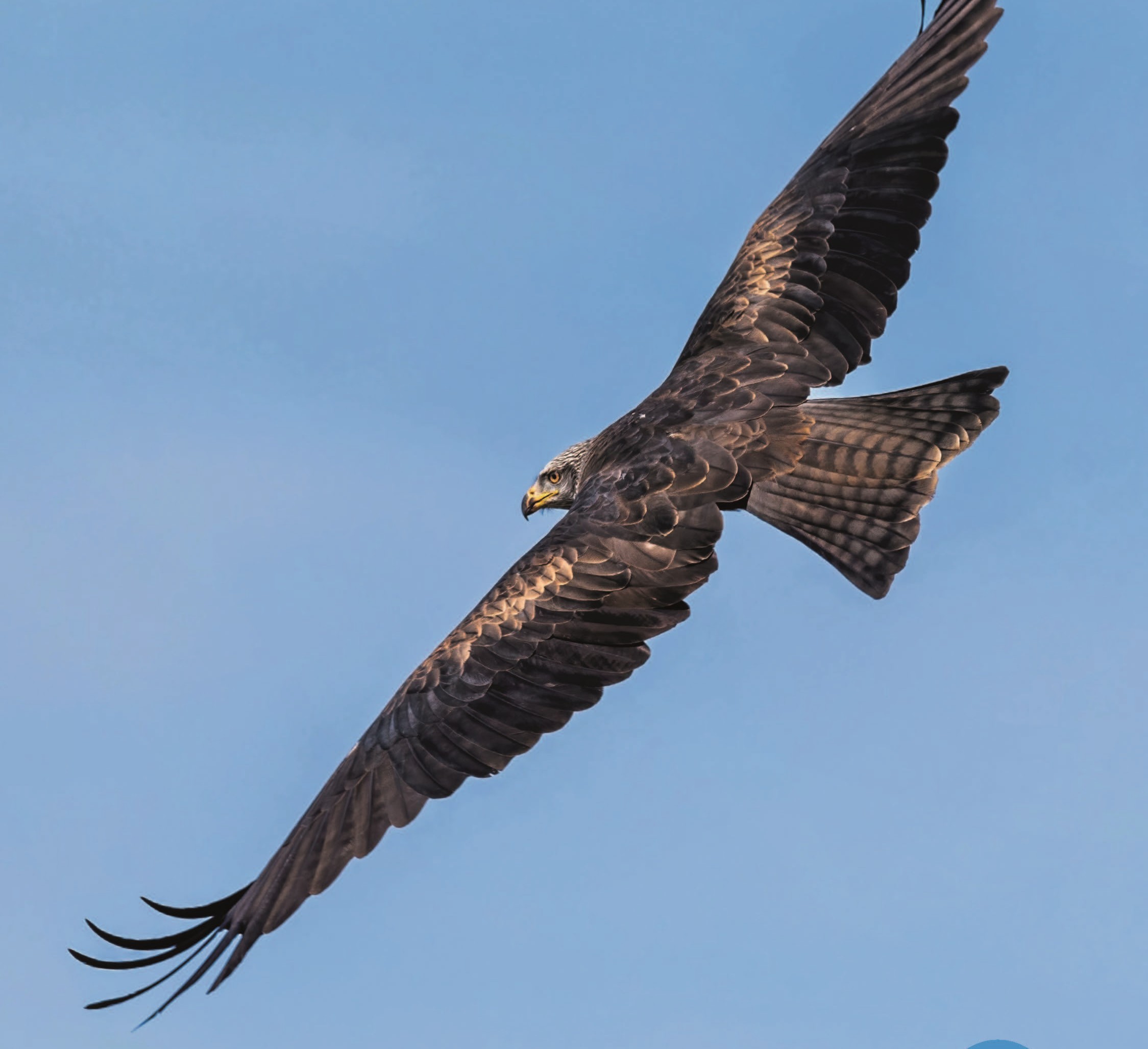
9 May: World Migratory Bird Day, unveiling the Migration and Journeys of the Black Kite
- SEO/BirdLife presents a new publication on migratory behaviour as part of the celebration of World Migratory Bird Day, which this year takes place on 9 May, thanks to the collaboration of the Iberdrola Spain Foundation.
- The publication Spatial Behaviour of the Spanish Black Kite Population shows the movements of 25 individuals fitted with remote tracking systems, providing new insights and previously unpublished data that highlight the importance of the Strait of Gibraltar for migration, the barrier posed by the Sahara Desert, and the relevance of the Sahel region.
- This information is highly valuable for implementing species conservation actions, thus contributing to one of the key agreements of the latest meeting of the Convention on Migratory Species (CMS), which recognised a new protection category: Internationally Important Areas for Raptors.
The publication Spatial Behavior of the Spanish Black Kite Population, coordinated by SEO/Birdlife with the participation of the University of Alicante and the support of the Iberdrola Spain Foundation, has made it possible to gain detailed knowledge—previously undescribed—of numerous aspects of the ecology and behavior of this species.
This detailed and up-to-date study of the species’ movements answers many questions related to the spatial behavior of its populations. Thanks to the tagging of twenty-five individuals with remote tracking devices, previously unknown aspects have been described, such as the time taken to reach wintering grounds or the size of the area used during the breeding period.
SEO/Birdlife highlights that this study confirms the importance of the Strait of Gibraltar for the migration of soaring birds as a key point on the Western European migratory route. It also demonstrates the major barrier posed by the Sahara Desert for trans-Saharan migratory birds and how the black kite overcomes this challenge.
Another key conclusion is the importance of the Sahel for this species, as for others already analyzed within the Migra Programmed, such as the lesser kestrel or the booted eagle. This region is crucial for the winter survival of millions of European birds that leave Europe in search of optimal feeding areas.
Migratory Journeys
Tracking Spanish black kites with GPS systems made it possible to reconstruct seventy-two complete migrations from nineteen individuals (out of the twenty-five tagged). The results show that annual movements between Iberian breeding territories and Sahelian wintering areas follow two contrasting strategies depending on the period of the annual cycle: a fast and direct post-breeding migration, and a slower, more dispersed, and flexible pre-breeding migration.
During the post-breeding migration, which takes place between late July and mid-August, black kites travel an average of 4,300 km in short journeys, lasting less than three weeks. This movement is characterized by remarkably similar routes between individuals, with most crossing the Strait of Gibraltar and advancing directly through the western Sahara, making few and short stopovers concentrated in North Africa.
In contrast, the pre-breeding migration, between mid-February and late March, is longer and more variable. Journeys last around 30 days and cover greater distances, 5,250 km, progressing at a slower daily pace and following much more dispersed routes.
“Thanks to information from birds tagged with traditional systems, we already knew that the Sahel region marked the southern limit of their journeys. Now, thanks to GPS devices, we have been able to define in detail their routes, how they circumvent the Sahara Desert to reach their destination, their resting points, and exactly how long they remain in the region,”
explains Juan Carlos del Moral, coordinator of SEO/BirdLife’s Bird Monitoring Area.
Breeding Season Behavior
The data reveal that the average onset of black kite breeding occurs around 22 March, with males arriving slightly earlier than females, to establish territories and repair nests. Breeding ends around 28 July, with no differences between sexes, resulting in a total duration of approximately 127 days.
One surprising finding is that kites located in more northern regions begin and end breeding earlier than those in southern areas, a pattern opposite to that observed in other species.
Another notable aspect is the size of the total home range during this period, which can exceed an average of 220 km², with some individuals using more than 3,200 km². On a weekly basis, the home range is reduced to about 63 km², and the core area to around 8 km², reflecting the strong centrality of the nest during incubation and the first days of chick rearing.
Regarding breeding areas, high interannual fidelity was observed, with an average overlap of 62.7% over the years, indicating that individuals consistently reuse the same areas.
Use of Landfills
The black kite is a scavenging bird and uses landfills as a food source with some regularity. Although 88% of the tagged individuals visited at least one landfill during the study period, the frequency and intensity of these visits were low at the population level. Approximately 1.5% of locations were recorded within landfills, equivalent to an average of 20 minutes per day in these areas, and visits occurred one day out of ten. Around 5% of locations were within a 500-metre radius of these sites.
As a result, landfill use is not homogeneous throughout the year. It is much higher during migration, both pre- and post-breeding, and much lower during the breeding period, when only half of the kites visited landfills, and then only sporadically.
Black Kite Behaviour During Wintering in Africa
The study of the wintering period of tagged black kites provides a detailed view of a crucial phase of the annual cycle that has historically been poorly documented.
One of the main conclusions is that, of the three major periods—breeding, migration, and wintering—only wintering occupies half of the annual cycle, with an average duration of 181 days, from late August to mid-February. This is because the Sahel has become a highly productive region currently, facilitating survival during an unfavorable period in Europe.
Contrary to the idea of a sedentary phase, individuals show remarkable mobility. Black kites travel more than 17,000 km during wintering, with average daily movements close to 100 km. After arriving in wintering areas, they undertake an exploratory phase covering large areas of Mali, Burkina Faso, Niger, and Chad. From October onwards, coinciding with the advance of the dry season, movements become more directional, with a progressive shift southward and east–west dispersion in search of food-rich areas.
Advances in Migratory Bird Conservation
SEO/BirdLife makes the information contained in the publication Spatial Behaviour of the Spanish Black Kite Population available to society to promote conservation actions for the species, in line with one of the most relevant agreements of the latest CMS meeting, which established a new protection category: Internationally Important Areas for Raptors (IIARs).
The black kite is one of the most abundant and widely distributed raptors in the Iberian Peninsula. It is found in north-western Spain and is scarcer in the Mediterranean region. It nests in wooded habitats, but as a scavenger it is frequently seen in open countryside and agro-pastoral landscapes.
The only nationwide estimate available, based on a dedicated census of this and other forest species, placed the population at around 10,000 breeding pairs. This population is broadly stable in its traditional distribution areas, although expansion of its range limits and increased abundance in those areas has been observed.
Discover the Migra Programme
The Migra Programme, launched in 2011 by SEO/BirdLife in collaboration with the Iberdrola Spain Foundation, incorporates the latest geolocation and remote tracking technologies to gain a more detailed understanding of bird movements within and beyond Spain. This initiative provides information on the start and end dates of migrations, stopover and feeding sites, travel duration, route consistency between spring and autumn migrations, main wintering, and dispersal areas, and whether routes remain consistent year after year.
By November 2025, the Migra Programme had data from 1,501 tagged birds of forty-one distinct species. Between 2011 and 1 August 2025, 558 birds of twenty-nine species were tagged with funding from the Iberdrola Spain Foundation, while a further 762 individuals of twenty-five species were tagged thanks to collaboration with other organizations. In addition, data is available for 181 birds of thirteen species tagged before the programme began. Using this information, 11 migration monographs have been published.