
The Spanish Air and Space Force Headquarters will feature new exterior lighting thanks to a partnership between the Ministry of Defence and Fundación Iberdrola España
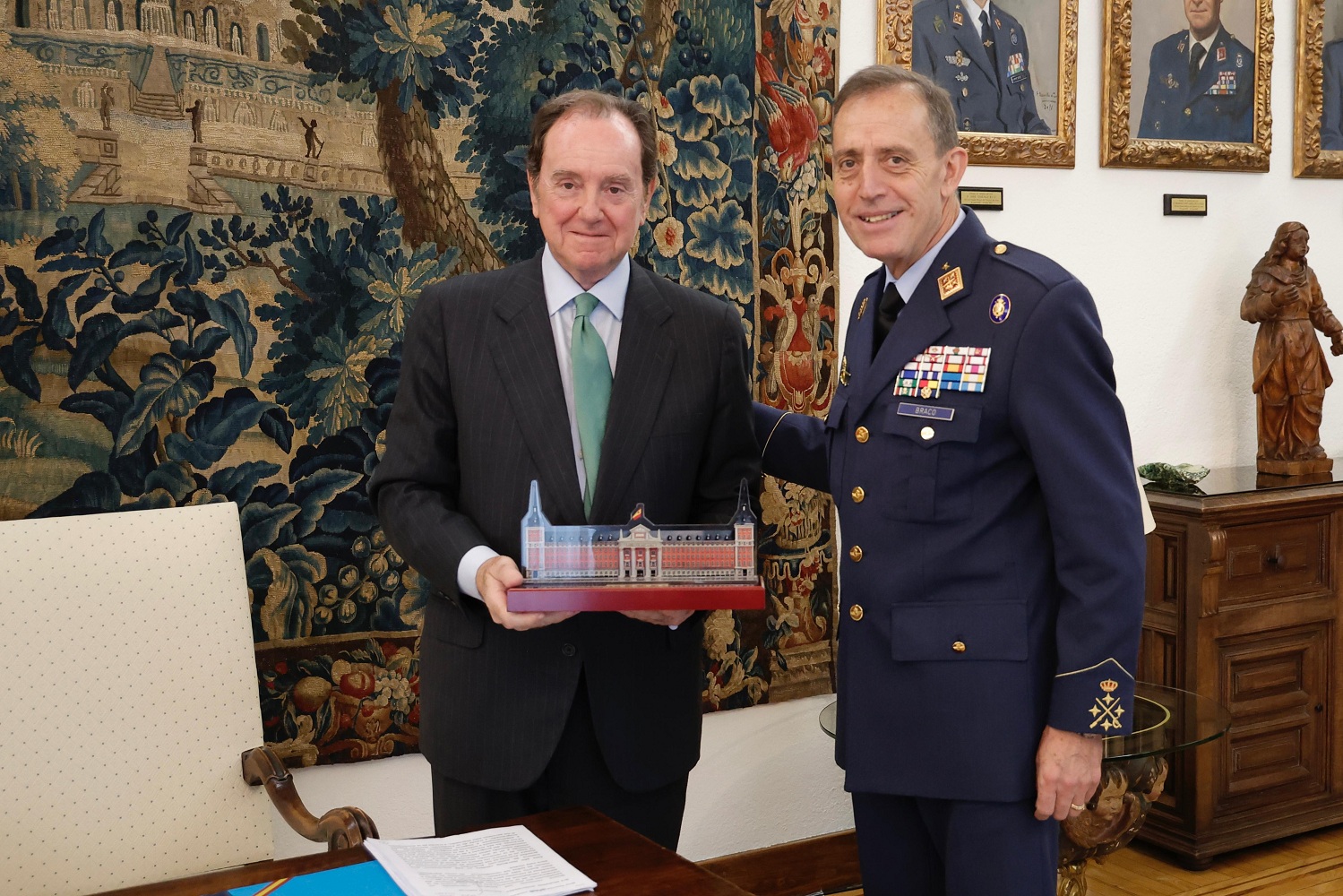
- Jaime Alfonsín, Chairman of Fundación Iberdrola España, and Air General Francisco Braco Carbó, Chief of Staff of the Spanish Air and Space Force, have signed an agreement to upgrade the lighting of one of Madrid’s most iconic buildings.
- The project, involving an investment of approximately €360,000, will incorporate state-of-the-art LED technology to highlight the building’s architectural features, improve energy efficiency and reduce CO₂ emissions.
The Ministry of Defence and Fundación Iberdrola España have signed an agreement, involving an investment of approximately €360,000, for the exterior architectural lighting of the Spanish Air and Space Force Headquarters, located in Plaza de la Moncloa in Madrid. The project will enhance the building’s architectural and cultural value, improve its visibility at night and strengthen its sustainability and energy efficiency.
In addition to Jaime Alfonsín and Air General Francisco Braco, the signing ceremony was attended by Ramón Castresana, Director of Fundación Iberdrola España; Elena Sanz, Head of Legal Services; and Antonio Collada, Head of Art and Culture and Biodiversity. Also in attendance were Major General Enrique Cuenca-Romero, Head of the Headquarters Group of the Spanish Air and Space Force; Borja Fanjul, Councillor-President of the Moncloa-Aravaca district; and Noemí Barbero of architectural lighting studio VBNB Lighting, who will develop the building’s architectural lighting design.
Jaime Alfonsín, Chairman of Fundación Iberdrola España, said: “Our partnership with the Ministry of Defence enables us to showcase one of Madrid’s iconic buildings and reinforce our commitment to the city’s historical and cultural heritage. The new lighting will highlight its architectural richness, improve its visibility at night and bring this landmark closer to the public.”
Air General Francisco Braco Carbó, Chief of Staff of the Spanish Air and Space Force, said: “This agreement at the Spanish Air and Space Force Headquarters completes your work with Spain’s Armed Forces in the field of heritage lighting. It also comes at a particularly special time for us, as we commemorate the centenary of the pioneering long-distance flights of Spanish military aviation. Once again, you are demonstrating your commitment to preserving and showcasing our historical heritage. I am convinced that illuminating this façade will further enhance Plaza de Moncloa and Calle de la Princesa, helping to improve the appearance of one of the main gateways to our city.”
An iconic Madrid landmark
The Spanish Air and Space Force Headquarters was designed by architect Luis Gutiérrez Soto. Built in the Neo-Herrerian style, it stands in Madrid’s Moncloa district on the former site of the city’s Modelo prison, and its architecture recalls the Monastery of El Escorial. Inspired by 18th-century architecture, the building combines exposed brick, granite and limestone on its façade, with slate roofs and terrazzo and marble flooring. It has six storeys, four towers topped by spires and a ceremonial entrance portico with four granite half-columns. The interior is arranged around three large courtyards: the central courtyard, or courtyard of honour, overlooked by the windows of the state rooms, and two others designed as squares.
Library and archive
The building also houses one of Spain’s most comprehensive libraries devoted to military aviation, with more than 19,000 titles, as well as the General Archive of the Spanish Air Force Headquarters, which is responsible for preserving and processing documentation from its different departments.
Protecting, conserving and showcasing heritage
Since 2011, Fundación Iberdrola España’s Lighting Programme has allocated more than €8 million to enhancing over 67 monuments across Spain. Its most notable projects include the ornamental lighting of the Basilica of the Royal Monastery of San Lorenzo de El Escorial; the ornamental lighting of the façade of the Congress of Deputies; the interior lighting of the church at the Monastery of El Paular; the exterior ornamental lighting of the Supreme Court; the Prado Museum gallery lighting project; and the ornamental lighting of the Royal Palace Chapel, among others.