
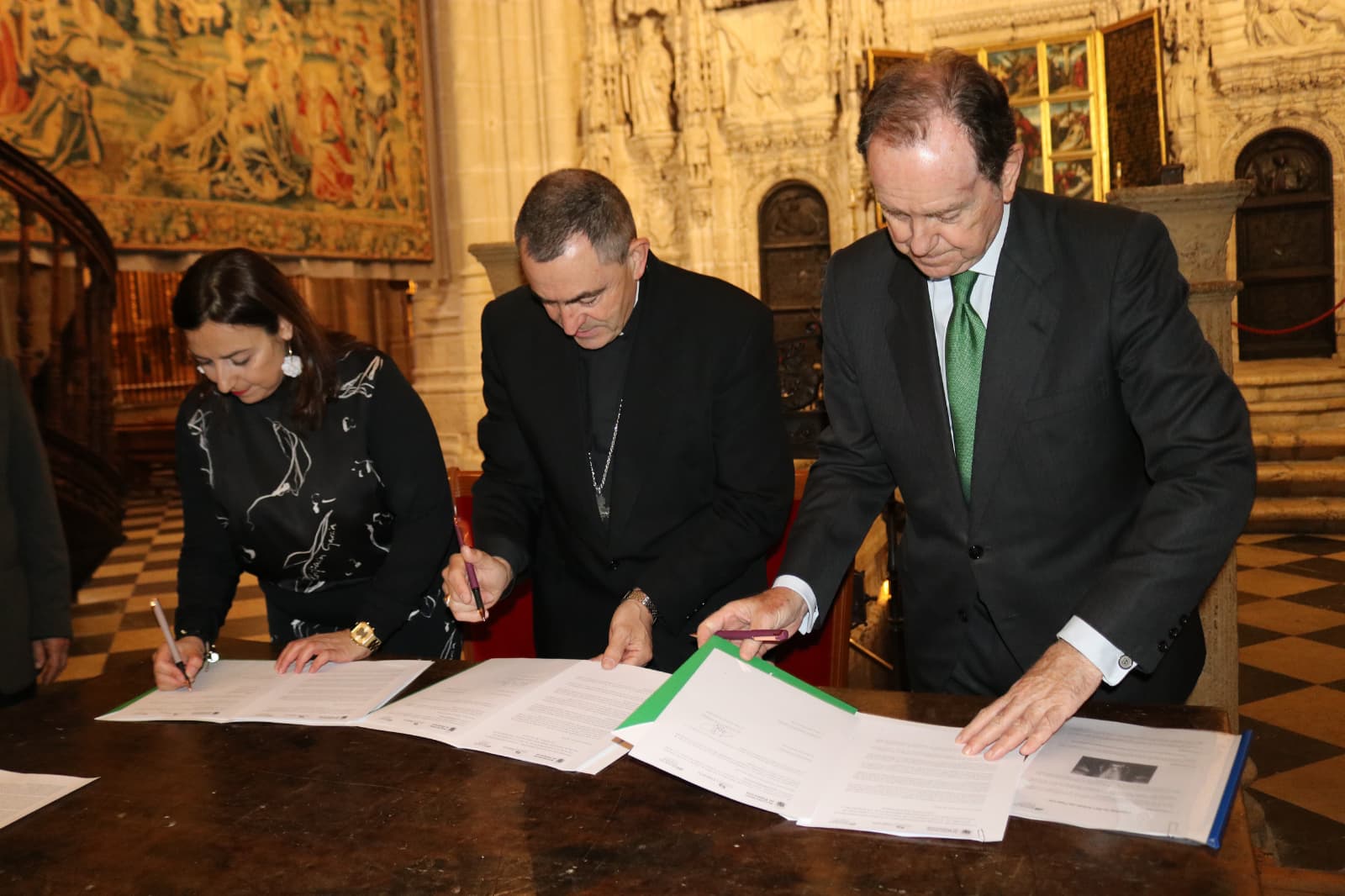
Fundación Iberdrola España will provide new exterior lighting for Palencia Cathedral after signing an agreement with the local Diocese and the City Council
- The agreement will allow the renovation of the exterior ornamental lighting of this cultural heritage monument using state‑of‑the‑art LED technology, restoring its splendor while reducing both energy consumption and CO₂ emissions.
- This initiative is part of the lighting program promoted by the company for its 125th anniversary.
The exterior of the Cathedral of Palencia will debut new ornamental lighting following the signing of a collaboration agreement between the Iberdrola Spain Foundation, the Diocese, and the City Council. The project, with an investment of 300,000 euros, includes the installation of next‑generation LED luminaires that will reduce the monument’s energy consumption and enhance the beauty of this heritage landmark of Castile and León, the third‑largest cathedral in Spain after those of Toledo and Seville.
The agreement was signed this morning in the cathedral’s retrochoir by the Bishop of the Diocese of Palencia, Monsignor Mikel Garciandía; the city’s mayor, Miriam Andrés; and the president of the Iberdrola Spain Foundation, Jaime Alfonsín, in the presence of the cathedral dean, Dionisio Antolín, and Iberdrola’s vice president, Juan Manuel González Serna.
The Bishop of the Diocese of Palencia noted, as he did during his ordination in the cathedral, that buildings like this must stop being “mortuaries” anchored in the past and become “maternity wards” that continue generating life. In this sense, he emphasized that initiatives such as the new exterior lighting demonstrate that a cathedral is a living organism, whose vitality is built day by day by the faithful. He also highlighted that the light in the cathedral carries “a wonderful symbolic meaning.”
Likewise, the mayor of Palencia, Miriam Andrés, who began her remarks by thanking the Iberdrola Spain Foundation for having “set its sights” on the Cathedral of Palencia, stressed that the exterior lighting to be installed in the Plaza de la Inmaculada will provide “added value to the city’s main monument, as it is the one that receives the highest number of visitors.” She pointed out that “it will enhance it, doing it justice, since the cathedral is surrounded by buildings and its grandeur and dimensions cannot truly be appreciated. Therefore, well‑designed and well‑planned lighting will give it its rightful place as the third‑largest cathedral in Spain and will highlight both its beauty and its surroundings.”
For his part, the president of the Iberdrola Spain Foundation, Jaime Alfonsín, emphasized that “with this lighting intervention, the Foundation reinforces the value of the Cathedral of Palencia, an essential landmark of the historical and artistic heritage of Castile and León and of our country. This initiative reflects our firm commitment to preserving cultural heritage through efficient and environmentally respectful technological solutions that enhance the architectural features of the temple, improve its visibility, and strengthen its cultural presence for the city and its visitors.”
Origin and History of the Cathedral
The Cathedral of Palencia, or Cathedral of San Antolín, is located in the historic center of the city, historically known as the “Unknown Beauty,” now being rebranded as the “Recognized Beauty.” Its construction spanned fourteen centuries, reflecting the historical and artistic evolution of the temple. It was one of the first monuments in Palencia to be declared a National Monument, in 1929.
Although the province is especially known for its Romanesque architecture, the cathedral is primarily Gothic. Its exterior is characterized by the sobriety of its walls, contrasted with the ornamental richness of certain portals and the apse. The building has five doors distributed across its three main façades.
The San Antolín Door opens the cathedral from the western façade, facing the Carrión River and the Plaza de San Antolín. This façade stands out for its large Gothic rose window and an adjoining 18th‑century chapel with an octagonal floor plan and a dome visible from the outside. On the northern façade, facing the Plaza de Cervantes, are the Door of the Kings or San Juan Door—in Flamboyant Gothic style—and the Canons’ Door. Finally, on the southern façade, located in the Plaza de la Inmaculada, we find the Salvador Door or Bride and Groom’s Door—with simple Gothic decoration—the cathedral tower, with straight lines and an austere appearance, featuring a clock and several windows, and the largest and most decorated door of the temple: the Bishop’s Door or Santa María Door, dating from the 15th–16th centuries.
125 Years of Light: A Broad Calendar of Activities for Society
This agreement is part of the wide and varied program designed for 2026 to celebrate the 125th anniversary of Iberdrola’s founding, which includes art exhibitions, music festivals, technological showcases, and social events. Under the motto 125 Years of Light, the company has launched initiatives aimed at employees, customers, shareholders, and the public to bring its legacy closer to society and to share its vision, outlook, and strong commitment to the communities where it operates.
The Foundation: Care, Conservation, and Enhancement of Heritage
One of the principal areas of activity of the Iberdrola Spain Foundation is the care, conservation, and enhancement of historical and artistic heritage. Since 2011, the Foundation’s Lighting Program has allocated more than three million euros to improve over forty monuments across the country. Among the most notable projects in Castile and León are the exterior lighting of the Cathedral of Ávila, the interior lighting of the Cathedral of Palencia, the New Cathedral of Salamanca, the Church of San Hipólito, the Church of San Pedro Ad Vincula in Salamanca, the quadruple lock of the Canal de Castilla, the Basilica of San Juan de Baños—considered the oldest standing church in Spain—and the Cavalry Academy of Valladolid.