The Fuente Agria shines with its new ornamental lighting, thanks to the collaboration between Fundación Iberdrola España and the Puertollano City Council
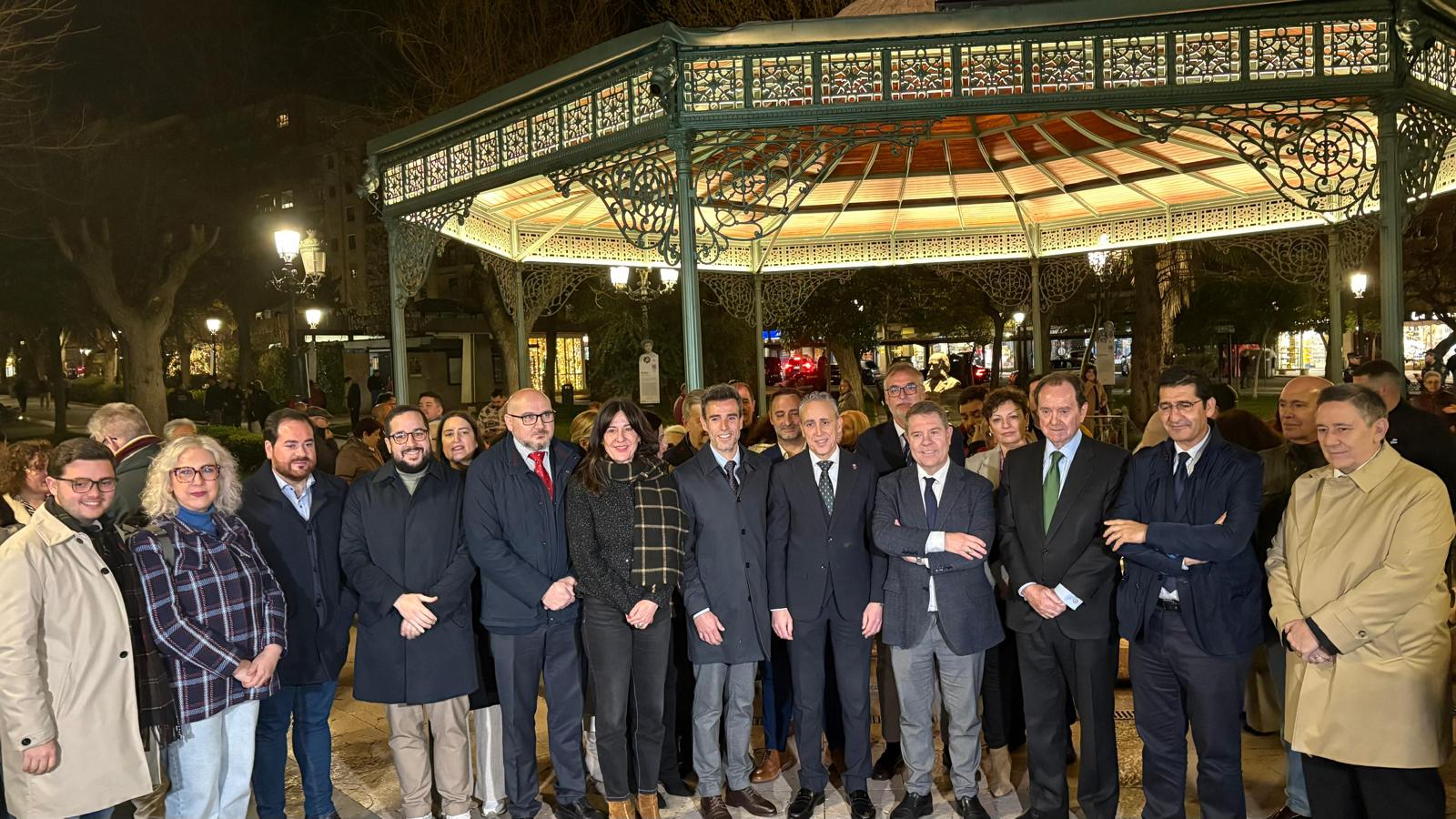
- With this new lighting intervention, supported by state‑of‑the‑art LED technologies, the fountain and its pavilion now present a renewed appearance that is more sustainable and better integrated into their surroundings
- This new initiative in the region of Castilla-La Mancha highlights the importance that Fundación Iberdrola España places on preserving historical and cultural heritage, both in this autonomous community and throughout Spain
Fundación Iberdrola España and the Puertollano City Council, together with representatives of the Regional Government of Castilla-La Mancha, have inaugurated this afternoon the new ornamental lighting of the Fuente Agria in the Paseo de San Gregorio park, one of the city’s most iconic and visited landmarks.
The ceremony was attended by the Mayor, Miguel Ángel Ruiz; the President of Fundación Iberdrola España, Jaime Alfonsín; and the President of the Regional Government of Castilla-La Mancha, Emiliano García-Page. The initiative reflects the shared commitment of both institutions to the conservation of historical and cultural heritage, as well as to improving urban spaces and their sustainability.
The project, valued at 46,398 euros, consisted of installing a high-efficiency LED lighting system designed to highlight, beautify, and harmonize the architectural elements of the ensemble, declared a Site of Cultural Interest (BIC) in 2024. Thanks to this intervention, the monument now features more sustainable, warmer, and low‑consumption lighting, with a total installed power of 1,020.80 W. During the event, DIRDAM36, the architectural firm responsible for the intervention, explained in detail the positioning process of the new luminaires placed on the Fountain and its Pavilion.
The event was also attended by José Manuel Caballero, Second Vice‑President of the Regional Government; Fernández, Delegate of the Junta in Ciudad Real; Ramón Castresana; and Iberdrola’s Institutional Delegate in the region, Óscar Narros, among others.
Emiliano García‑Page: “Iberdrola maintains a collaboration that goes beyond specific actions and looks to the future of the region”
During the inauguration, the Regional President stated that “Iberdrola maintains with Castilla-La Mancha a strategic collaboration that goes beyond specific actions and looks to the future of the territory. It is a relationship of trust and commitment that enables initiatives that improve our public spaces, reinforce our heritage, and demonstrate that cooperation between institutions and companies can translate into projects that benefit citizens.”
He also highlighted that “in places like Puertollano, new opportunities linked to the energy sector are emerging, with projects capable of generating economic activity, employment, and development for the region.”
Mayor Miguel Ángel Ruiz thanked Fundación Iberdrola for helping to beautify one of Puertollano’s most emblematic sites, “an initiative that restores the prominence that the Fuente Agria deserves in the history of our city.” He added that with initiatives like this, “we continue building the Puertollano we want: a city that looks to the future, linked to energy and the energy transition, but without ever forgetting our roots.”
He reiterated the city’s gratitude to Fundación Iberdrola for its commitment to heritage and its collaboration with public institutions to improve spaces that form part of the identity of all residents of Puertollano: “with interventions like this, we also illuminate our history and our pride as a city.”
For his part, Jaime Alfonsín stated that “for the Foundation, projects like the one we inaugurate today in Puertollano represent our firm commitment to the preservation of heritage and the enhancement of unique spaces such as the Fuente Agria—always through efficient and sustainable solutions that aim both to beautify the monument and to ensure that future generations can continue enjoying it.” Alfonsín also underscored that this year is “a very important year for both the Foundation and the company, as we commemorate the 125th anniversary of Iberdrola.”
Origin and history of the Fuente Agria
More than 500 years old, this monument is located on the Paseo de San Gregorio, in the heart of the town, surrounded by landscaped areas and close to the historic Casa de Baños and the municipal market.
The Fuente Agria is a natural spring of carbonic and ferruginous water, its origin linked to the extinct volcanic activity of the Campo de Calatrava area. This makes it a geological feature of interest for natural parks that study and highlight the geology and heritage of a given territory.
The Fuente Agria is already documented in the 14th century as “Fuente Aceda,” which may have originated in Roman times. From the reign of Philip II, around 1575, references appear in which the King remarks on the fountain’s sour taste and warm temperature.
From the late 17th century onward, the first bibliographic documents are known: a small booklet by Italian physician Felipe Vizani del Águila (1685), describing the health benefits of drinking the sour waters of Puertollano, and the work of Doctor Alfonso Limón Montero, Espejo Cristalina de las Aguas de España (1697), in which he mentions the “sour waters of the town of Puertollano and their medicinal properties.”
The Fuente Agria and its Pavilion
In 1876, a kiosk and railing were built, with José Vicente Gonzalo responsible for the work. The structure of the Fountain was later described by Hervás y Buendía in his Dictionary of the Province of Ciudad Real, where he explains that the spring was initially a simple pool, then contained in a wooden tank reinforced with stone and lime around 1600. Later, in 1733, a small pavilion was built over this basin, enclosed with a door to control visitor access, with two spouts—one for the sick and one for the general public.
In 1892, a metal octagonal kiosk of industrial character was designed to protect the fountain from the elements. However, only a few years later, in 1910, further works were undertaken and the fountain acquired the appearance it still has today, which continues to attract locals who drink from its waters.
125 Years of Light: a broad programme of initiatives for society
This agreement forms part of the extensive and diverse programme created for 2026 to commemorate the 125th anniversary of Iberdrola, which includes art exhibitions, music festivals, technological showcases, and social events. Under the slogan 125 Years of Light, the company will launch initiatives in Castilla‑La Mancha aimed at employees, customers, shareholders, and the general public to bring its legacy closer to society and share its vision, future outlook, and strong commitment to the communities where it operates.
Iberdrola and its commitment to art and culture
One of Iberdrola’s main areas of activity, through its foundation in Spain, focuses on the care, conservation, and enhancement of historical and artistic heritage. The Lighting Programme aims to install or improve interior and exterior lighting systems in unique buildings in order to showcase their artistic and historical value.
Since 2012, investment in this programme in Castilla-La Mancha has reached 1,229,238 euros, improving 15 heritage elements, including:
- the interior of the Santa María La Blanca Synagogue in Toledo,
- the Basilica of Our Lady of Prado in Talavera de la Reina,
- the exterior lighting of the Cathedral of Sigüenza and its Plaza Mayor,
- the Roman Bridge in Talavera de la Reina,
- the historic windmills of Campo de Criptana in Ciudad Real,
- the Henares Bridge in Guadalajara,
- and the San Antón Bridge in Cuenca (2024).
- Currently, three additional projects are underway in the region: the illumination of the Cathedral of Albacete; the interior lighting of the Hermitage of Our Lady of Belén in Liétor, Albacete; and the illumination of the Basilica of Our Lady of the Assumption of Villanueva de la Jara in Cuenca, as well as several actions in Mira in response to storm damage.