
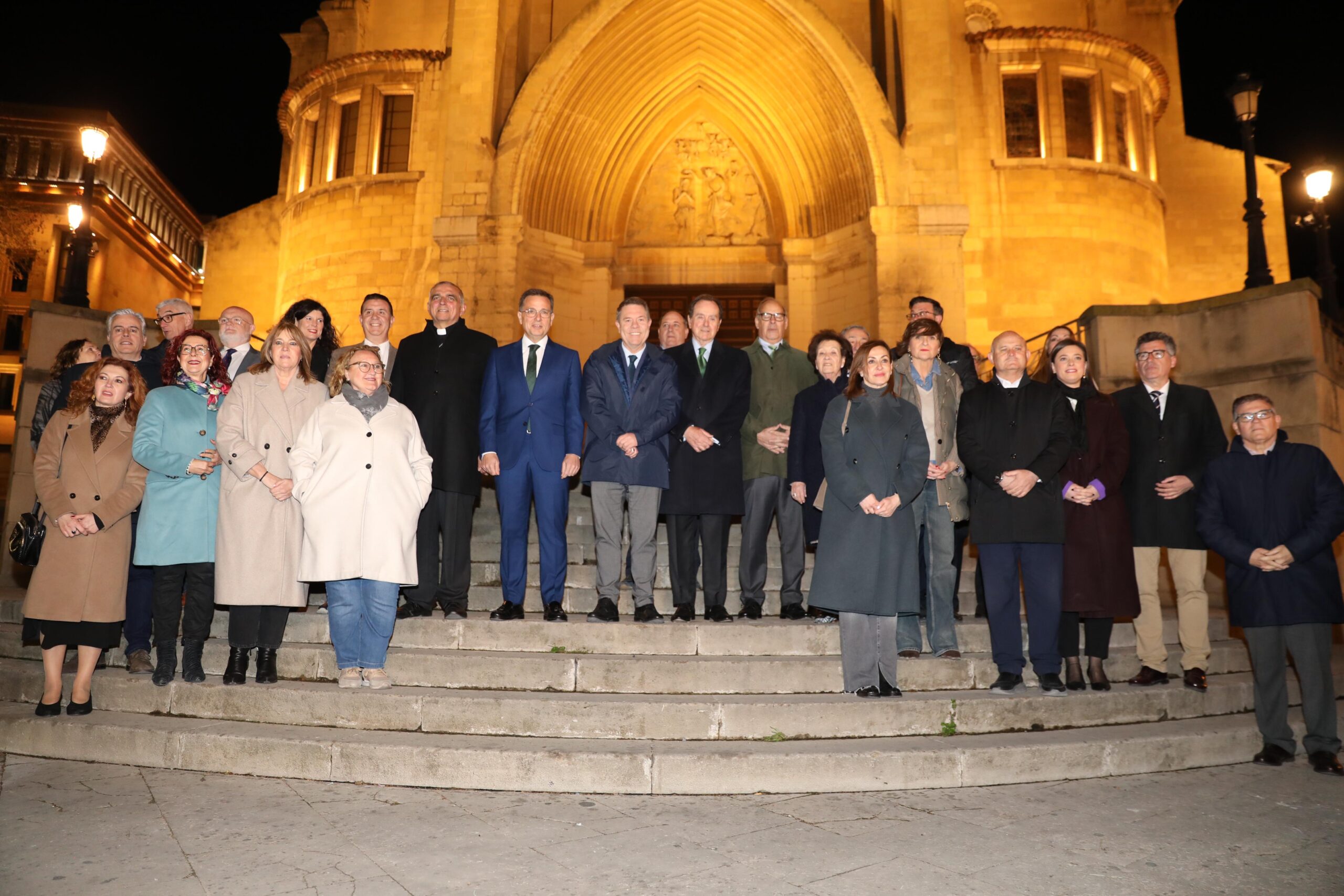
The new exterior lighting enhances the beauty of the Cathedral of St. John the Baptist in Albacete, thanks to Fundación Iberdrola España
- With this intervention, the Foundation helps highlight one of the major landmarks of the historical and religious heritage of Castilla-La Mancha, strengthening its presence and relevance within the region’s monumental ensemble
- This agreement is part of the many initiatives included in Iberdrola’s 125th anniversary programme to bring its legacy closer to society as a whole
The Cathedral of St. John the Baptist in Albacete now features a renewed exterior ornamental lighting system that enhances its artistic, heritage, and spiritual value, thanks to an initiative promoted by Fundación Iberdrola España in collaboration with the Diocese of Albacete and the City Council. This intervention is part of the agreement signed by the three institutions to equip the temple with modern, efficient, and environmentally respectful lighting.
This project, valued at 150,000 euros, has made it possible to illuminate not only a temple, but an essential part of the cultural soul of Castilla-La Mancha. Using state‑of‑the‑art LED technology, the initiative brings sustainability, modernity, and a 63% reduction in electricity consumption without compromising the essence of the building, allowing the Cathedral to shine with renewed light while remaining rooted in its memory on the Manchegan plain.
The signing ceremony, held inside the cathedral, was attended by, among others, Emiliano García‑Page, President of the Regional Government of Castilla-La Mancha; the Mayor of Albacete, Manuel Serrano López, accompanied by councillors Francisco Navarro, Elena Serrallé, Julián Garijo, Llanos Navarro, Rosa González de la Aleja, and Alberto Reina; the Bishop of Albacete, Mons. Ángel Román Idígoras; the Vicar General of the Diocese, Julián Ros; Mario Ruiz‑Tagle, CEO of Iberdrola España; Santiago Martínez Garrido, Secretary General of the Iberdrola Board; Jaime Alfonsín Alfonso, President of Fundación Iberdrola España España; Ramón Castresana, its director; as well as Óscar Narros, Iberdrola’s institutional delegate in Castilla-La Mancha, among others.
Emiliano García‑Page, President of Castilla‑La Mancha, praised Fundación Iberdrola’s commitment to the conservation and enhancement of historical heritage through sustainable technological solutions, highlighting that these kinds of initiatives “prove that it is possible to combine heritage protection with energy efficiency and respect for the environment.” He stressed that cooperation between institutions and businesses makes it possible to promote projects that “strengthen collective identity, improve the image of our cities and create opportunities linked to tourism and culture.” García‑Page emphasised that initiatives such as the new lighting of the Albacete cathedral show how innovation applied to heritage “helps project a modern Castilla-La Mancha, committed to sustainability and proud of its historical legacy.”
Mons. Ángel Román Idígoras expressed his gratitude to Fundación Iberdrola and the City Council for making the cathedral’s exterior lighting possible. “I also thank Noemí Barbero for the sensitivity and Christian spirituality she has infused into this lighting.” “The light,” continued the bishop, “also allows the building to speak boldly yet kindly. It presents itself as a beacon in the night; as a home of listening and welcome; as a mother who keeps watch over her children at all times. All who see it will be able to contemplate and enjoy the beauty of the building. And we will feel the safety of knowing we are accompanied. ‘I walk with you,’ Jesus tells us, and ‘I walk with you,’ the Church tells us.”
For his part, Jaime Alfonsín, President of Fundación Iberdrola España, stated that “for Fundación Iberdrola España, illuminating the Cathedral of Albacete means accompanying the city in preserving one of its greatest symbols. This new light, conceived with respect and modernity, seeks to highlight the silent beauty of the temple and offer citizens a radiance that strengthens their bond with its history and collective identity.” Alfonsín also recalled that, throughout the year, for Iberdrola’s 125th anniversary, the company has prepared a wide range of activities for society as a whole.
The Mayor of Albacete, Manuel Serrano López, highlighted the collaboration with Fundación Iberdrola “because thanks to the social responsibility of a leading company, our Cathedral will be able to have new ornamental lighting that will help showcase one of our most emblematic monuments, all within the framework of Iberdrola’s 125th anniversary.” In his view, “this reinforces the role of this temple as a symbol of Albacete, and also as the home and seat of our Patroness, the Virgin of Los Llanos.” “We want to enhance the city’s historical heritage and make it known to our residents, so we can feel proud of what is ours and of our roots, and we also want to offer it as an attraction for visitors, because tourism is an essential driver of economic and social development,” he added.
Origin and history of the Cathedral
The Cathedral of Albacete, whose construction began in the 16th century, reflects an architectural evolution from late Gothic to Baroque and Neoclassical elements, the result of successive construction phases and various restorations. The temple has witnessed the urban and historical development of the city, becoming a key architectural landmark of the area.
Among its most distinctive features are its main façade, designed in a Neo-Gothic style, and above which rises a small square bell tower. In contrast, the south façade is Neo-Romanesque, featuring a portal with three archivolts of semicircular arches. Inside, the four Ionic columns, more than 13 metres high, draw particular attention. They are considered among the most representative of Spanish Renaissance architecture and frame the Chapel of the Virgin of Los Llanos, notable for its artistic value and its blend of Baroque and Neoclassical elements, along with the 75 square metres of oil-painted murals created by Casimiro Escribá without assistance from a workshop or pupils.
The Foundation’s commitment to promoting art and culture
One of the main areas of activity of Iberdrola, through its foundation in Spain, focuses on the care, conservation, and enhancement of historical and artistic heritage. The Lighting Programme’s primary aim is to carry out interventions in unique buildings to install or improve their interior and/or exterior lighting systems in order to contribute to showcasing their historical and artistic value. In Castilla-La Mancha, these include the interior and exterior of the Cristo de la Luz Mosque; the façade of the Chapel of San Bernardo in Oropesa; the tower of the Church of Santo Tomé in Toledo; the interior of the Santa María La Blanca Synagogue in the regional capital; the renovation of the permanent collection rooms at the Army Museum; the façade of the Monastery of Uclés in Cuenca; the interior of the church in Valdepeñas in Ciudad Real; the Basilica of Our Lady of Prado in Talavera de la Reina; the Plaza Mayor of Sigüenza and its cathedral in Guadalajara; the Roman Bridge in Talavera de la Reina; as well as the lighting of the historic windmills of Campo de Criptana, the illumination of the Bridge of the Henares in the Alcarria capital, the San Antón Bridge in the province of Cuenca, and the Fuente Agria fountain in Puertollano.
125 Years of Light: A broad programme for society as a whole
This agreement is part of the extensive and varied programme created for 2026 to mark the 125th anniversary of Iberdrola’s founding, which includes art exhibitions, music festivals, technological showcases, and social events. Under the motto 125 Years of Light, the company will launch initiatives aimed at its employees, customers, shareholders, and the general public to bring its legacy closer to society and, above all, to share its vision, future outlook, and strong commitment to the communities in which it operates.