
The Prado’s Restoration of Pablo de Valladolid Sheds New Light on Velázquez’s Artistic Vision
- The Museo del Prado has completed the restoration of Pablo de Valladolid, one of the most celebrated works by Diego Velázquez and described by Édouard Manet as “the most astonishing painting ever painted.” The project forms part of the Museum’s Painting Conservation Programme, supported by the Iberdrola Spain Foundation as a principal sponsor of the Prado’s Restoration Programme.
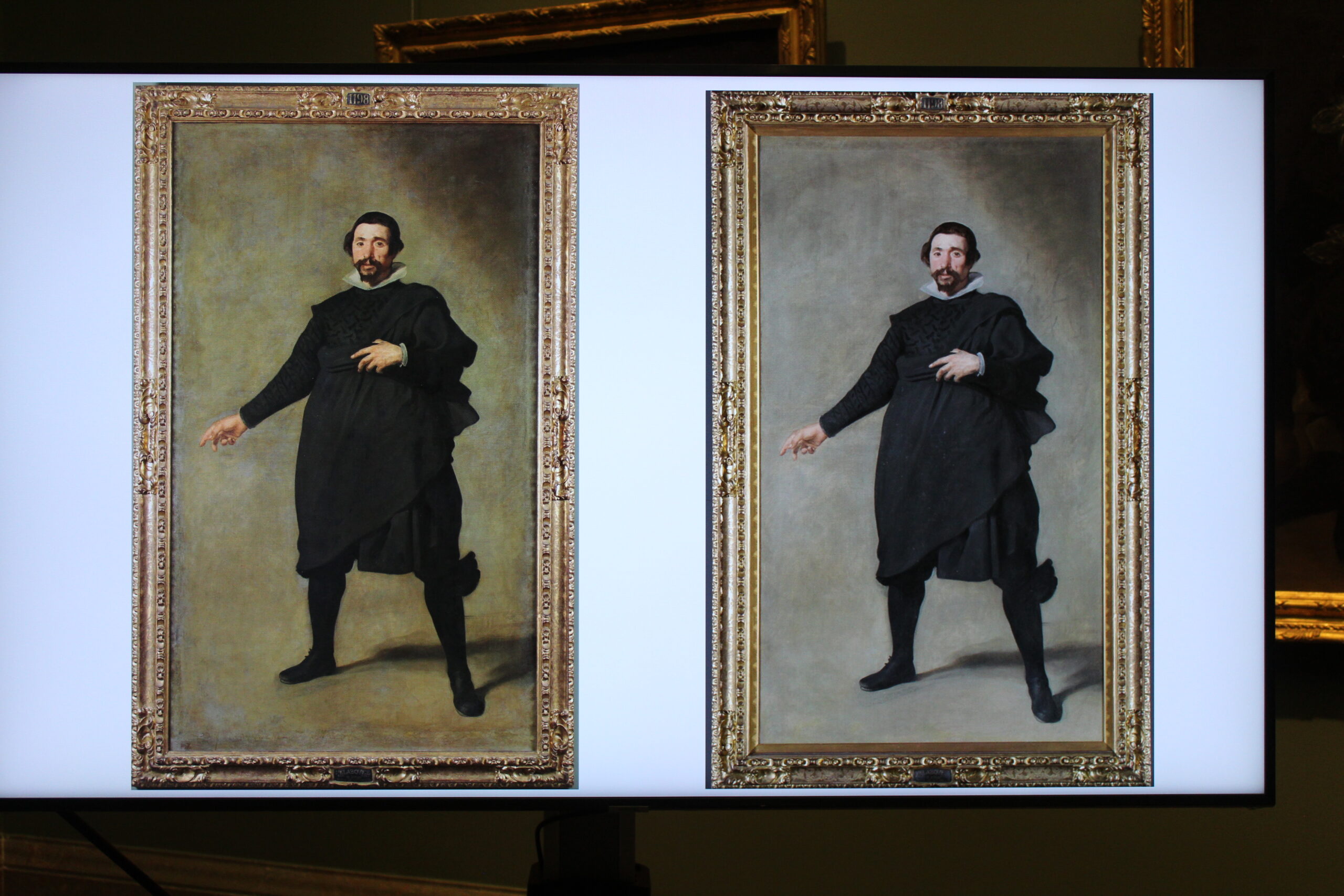
- The intervention has restored the original appearance of the canvas by recovering its initial dimensions and re-establishing the delicate balance between the figure and the surrounding space—an essential aspect for understanding the modernity and daring of Velázquez’s pictorial language.
In recent years, the Museo del Prado has been conducting an extensive restoration initiative focusing on several works by Velázquez that had not been treated since the major conservation campaign of the 1980s. The programme aims to ensure the long-term preservation of these paintings while restoring, as far as possible, the aesthetic and expressive values conceived by the artist.
Pablo de Valladolid holds a unique place in art history. Velázquez dispenses with architectural and landscape references, constructing the pictorial space solely through the body of the jester, the shadow he casts, and the surrounding air. This radical solution—exceptionally advanced for its time—makes the figure the absolute focal point of the composition and explains the powerful sense of presence and three-dimensionality conveyed by the work.
Although the painting had reached the present day in good overall condition, it bore historical alterations that affected the relationship between the figure and its environment. In the 18th century, the canvas was enlarged through the addition of fabric strips on both sides and along the lower edge. Later repainting campaigns further altered the chromatic balance, as their tones had darkened and shifted over time.
One of the main objectives of the current restoration was therefore to reinstate the original dimensions of the painting. The decision was taken to preserve the added canvas strips, given their historical significance, while concealing them beneath a newly designed frame using a non-invasive internal rabbet system. This solution allows visitors to view exclusively the surface painted by Velázquez, offering an image remarkably close to the original conception.
State-of-the-art X-radiography played a key role in precisely determining the original dimensions of the canvas and analysing later enlargements. Subsequent study using Aracne software revealed that the three added strips came from the same piece of cloth and were attached at a single point in time.
Advanced infrared reflectography techniques have also provided unprecedented insight into Velázquez’s creative process. Unlike earlier studies based on a single wavelength, the use of new multi-spectral cameras allowed for the examination of more than a dozen ranges, revealing an underlying freehand brush drawing of remarkable spontaneity and quality, with numerous corrections and compositional adjustments.
These techniques also facilitated the identification and removal of non-original repainting, which showed identical reflectance to that found on later additions. Pigment analysis confirmed the presence of an exceptionally light ground layer composed primarily of lead white, characteristic of this phase of Velázquez’s career, particularly in works created for the Buen Retiro Palace.
The study further revealed that the intense blacks of the jester’s costume were achieved through a combination of lamp black and charcoal black, both with bluish tones. The similarity of the internal layers of the added canvas strips reinforced the conclusion that they originated from the same fabric.
According to Jaime Alfonsín, President of the Iberdrola Spain Foundation, “the extraordinary work carried out has restored the spatial and visual balance conceived by Velázquez, while the new technical studies offer an unprecedented perspective on his creative process.” He added that “initiatives such as this demonstrate the value of cultural patronage as a stable collaboration between institutions in the service of the public interest,” and highlighted the Foundation’s pride in supporting the Prado’s Restoration Programme, particularly when the results allow the public to enjoy masterpieces by one of the great figures of Spanish painting.
As a result of this intervention, Pablo de Valladolid has fully recovered its visual and conceptual strength. At the same time, the new technical studies reaffirm the extraordinary modernity and experimental character of one of the greatest masterpieces of the Spanish Golden Age.