
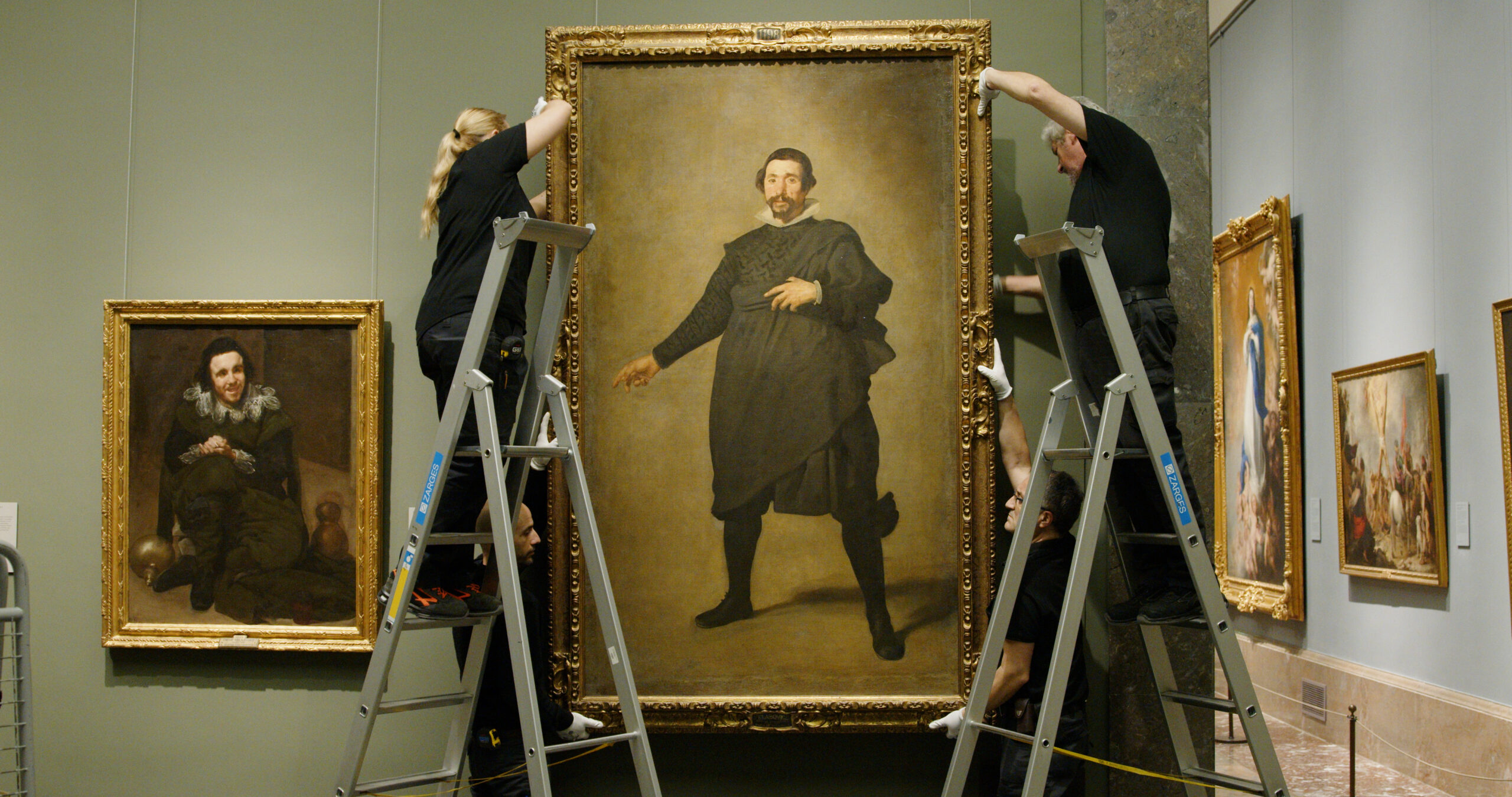
The Museo del Prado begins the restoration of Pablo de Valladolid by Velázquez, thanks to the Foundation
- The iconic painting by the Sevillian master, Pablo de Valladolid (c. 1635), leaves Room 15 of the Museo del Prado today to undergo a restoration process, sponsored by Fundación Iberdrola España
- This is one of the portraits in which Velázquez took the restriction of pictorial resources to the extreme in order to enhance the intensity and expressiveness of the figure depicted
- After visiting the Prado on September 1, 1865, the artist Édouard Manet—considered one of the fathers of Impressionism—wrote: “The background disappears; it is truly air that surrounds this poor man, all dressed in black and so full of life.”
Today, the Museo del Prado will move Velázquez’s Pablo de Valladolid to the restoration workshop to begin its technical analysis and subsequent intervention, thanks to the sponsorship of Fundación Iberdrola España as a “protecting member” of its Restoration Program.
The Portrait
Among the most distinctive portraits by Diego Velázquez are those dedicated to the court jesters and entertainers of Philip IV—a group of works in which the painter achieved some of his most audacious solutions. One of the most extraordinary examples is the portrait of Pablo de Valladolid, a documented figure in the service of the Court between 1632 and 1648, whose role likely reflected his interpretative talents or humorous character.
Velázquez portrays him as an isolated figure, firmly standing in an undefined space constructed solely through the shadow cast by his body. This radical simplification of the setting—without clear precedents in the painting of the era—turns the work into a true exercise in artistic innovation.
The neutral background focuses all attention on the subject’s gesture, captured in an attitude that has been interpreted as declamatory. The painting displays the blend of confidence and ease characteristic of Velázquez’s mature style, and stylistic analysis places it between 1632 and 1635, during the painter’s early years in royal service.
Significance
The portrait of Pablo de Valladolid has had a lasting influence. Francisco de Goya drew inspiration from it for his portrait of Francisco Cabarrús, and decades later, in 1865, Édouard Manet described this work as the finest of all paintings—a kind of artistic epiphany that changed the course of modern art.
Manet had traveled to Spain seeking to escape harsh criticism in Paris, and upon arriving at the Museo del Prado, he was utterly captivated by Velázquez’s technique, calling him the “painter of painters.” What most impressed the precursor of Impressionism was the absence of a background: Velázquez places the figure in an indeterminate space with no horizon line, no furniture, and no defined room. Only the shadows at the subject’s feet suggest the floor. In a famous letter to his friend, painter Henri Fantin‑Latour, Manet wrote: “It is perhaps the most astonishing piece of painting ever done… The background disappears; it is air that surrounds the man, dressed all in black and full of life.”
This experience triggered Manet’s radical simplification of his own style. The direct influence of Velázquez can be seen in The Fifer (1866), marking the beginning of modern artistic consciousness, far removed from mere imitation of the visible world.
The Restoration
Before restoration begins, several technical analyses will be carried out to expand the material information already known about the portrait. The recent acquisition of new research equipment by the Museo del Prado—funded through European Funds as part of the Recovery, Transformation and Resilience Plan (PRTR, 2024)—makes it possible to deepen the study of the painting through two complementary approaches: material analysis via XRF scanning and examination through multispectral infrared reflectography.
XRF scanning is a non‑destructive technique that identifies the chemical elements present on the pictorial surface. By stimulating the paint with X‑rays and analyzing the radiation emitted, it provides a detailed and unprecedented map of the materials used by the artist.
Multispectral infrared reflectography studies the painting’s response to different wavelengths, from visible to infrared (between 400 and 2600 nm). This analysis provides information according to depth and reveals details invisible to the naked eye.
The documentation obtained will contribute to a better understanding of the creative process and conservation condition of the painting and will serve as the basis for planning its restoration.
Fundación Iberdrola España, Protecting Member of the Museo del Prado
Fundación Iberdrola España develops one of its main areas of activity around the care and preservation of Spain’s cultural and artistic heritage.
Since 2010, Fundación Iberdrola España has held the status of “Protector” of the Museo Nacional del Prado, supporting the museum’s conservation and restoration programs, as well as funding four annual scholarships for young restorers. Thanks to this collaboration, interventions have been carried out on major works from the Prado’s collection, restoring the luminosity and depth envisioned by their creators, including Adam and Eve by Dürer; The Wine of Saint Martin’s Day and The Triumph of Death by Pieter Brueghel the Elder; The Mona Lisa from the workshop of Leonardo; The Adoration of the Magi and The Temptations of Saint Anthony by Bosch; The Annunciation by Fra Angelico; Goya’s Countess of Chinchón; the equestrian portraits by Velázquez; and most pieces in the Dauphin’s Treasure.
The Foundation also joined the Extraordinary Program for the Bicentennial of the Museo del Prado, particularly supporting the traveling exhibition throughout Spain.
125 Years of Light: A Broad Program of Initiatives for Society
This agreement is part of the extensive program designed for 2026 to mark Iberdrola’s 125th anniversary, which includes art exhibitions, music festivals, technological showcases, and social events. Under the motto “125 Years of Light,” the company will launch initiatives aimed at employees, customers, shareholders, and the general public to highlight its legacy, share its vision and future perspectives, and reaffirm its strong commitment to the communities in which it operates.