
The Cathedral of Santa María la Mayor in Tudela will feature new exterior ornamental lighting thanks to Fundación Iberdrola España
- Through this collaboration agreement with the Cathedral Chapter of Tudela and the City Council, the exterior lighting of the cathedral will be renewed with state‑of‑the‑art LED technology, which will reduce the building’s energy consumption as well as its CO₂ emissions
- This initiative by Fundación Iberdrola España seeks to highlight the historical and cultural heritage of one of the most notable landmarks of monumental Navarre
- Likewise, this future lighting renovation is part of the activities of the Lighting Program planned for the company’s 125th anniversary
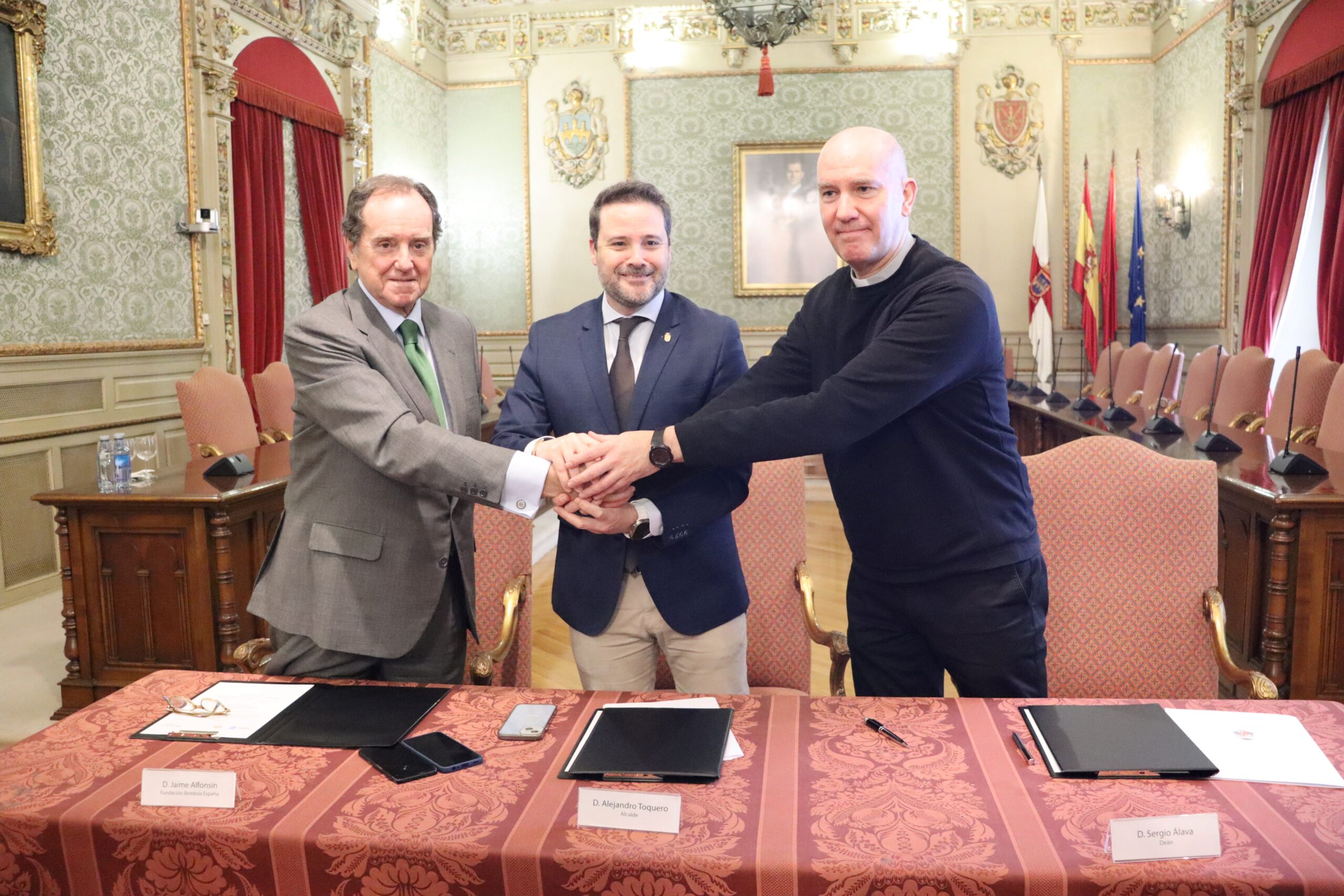
The Cathedral of Santa María la Mayor of Tudela will feature a new exterior ornamental lighting system following the signing of the agreement between Fundación Iberdrola España, the Cathedral Chapter of Tudela and the City Council.
The project, with an investment of 250,000 euros, includes the installation of new state‑of‑the‑art LED luminaires aimed at reducing the cathedral’s energy consumption while enhancing its architectural, cultural, and religious heritage. This investment seeks to highlight the beauty of the proto‑Gothic monument, which retains numerous Romanesque elements, as construction began at the end of the 12th century on the site of a former 9th‑century mosque.
The signing ceremony, held in the Plenary Hall of the Tudela City Council, was attended by the Dean of the Cathedral, Mons. Sergio Álava; the Mayor of Tudela, Alejandro Toquero; Jaime Alfonsín Alfonso, president of Fundación Iberdrola España; as well as the company’s institutional delegate in the Chartered Community of Navarre, Eduardo Ryan, among others.
Dean Sergio Álava emphasized that “the Cathedral was built as a beacon so that the people of Tudela and all who approached this temple could perceive that light that leads us to God, to transcendence.” For this reason, he thanked Fundación Iberdrola España for this generous initiative, noting that “the improvement and enhancement of the exterior lighting will guide parishioners toward the light of God that lies within the Cathedral and within each one of us.” He also thanked the City Council for its collaboration in making this exterior lighting possible.
For Jaime Alfonsín, president of Fundación Iberdrola España, “the Cathedral of Tudela is one of the great symbols of the heritage of the Chartered Community of Navarre. With this lighting intervention, we aim to highlight its architectural and artistic structure through a sustainable solution that respects its surroundings and aligns with its liturgical activity. In this way, Fundación Iberdrola España reinforces its commitment to culture, art and conservation during a very special year for Iberdrola, as the company celebrates its 125th anniversary.”
The mayor, Alejandro Toquero, after thanking the choice of Tudela and its cathedral for this new initiative within Fundación Iberdrola España’s Lighting Program, and highlighting the value of public‑private collaboration, stated that “this new lighting will allow us to simultaneously achieve energy savings and greater environmental sustainability; to reinforce pride in our roots and our legendary historical past by revealing architectural and artistic nuances that daylight does not allow us to appreciate; and, not least for our local economy, to promote night‑time tourism and, with it, commerce and hospitality.”
Origin and history of the Cathedral
Construction began in the 12th century on the remains of the former 9th‑century mosque, which had been renovated in the second half of the 10th century during the reign of Sancho VI el Sabio. The first documented works on the Romanesque cloister date to 1186. The church was dedicated in 1188, and the altar stone of the main altar was consecrated in 1204, during the time of Sancho VII el Fuerte.
The construction of the proto‑Gothic temple followed French schemes from the Languedoc region, with notable Cistercian influences. Work continued in the second half of the 13th century, during the reign of Theobald II of Navarre. The vaults were closed later, in the 14th century, or the roof structures were reconfigured at that time, at least in the central part of the nave.
Externally, the building features well‑cut ashlar walls topped with corbels, many of which were repurposed from the original mosque. The complex is completed by the small Gothic tower known as the “Auxa,” located to the right of the Puerta del Juicio, and a large Renaissance brick tower to the left.
Collegiate Church of Santa María
Originally, the building was conceived as the church of the Collegiate Church of Santa María, a status it maintained until 1784, when it was elevated to cathedral rank by Pope Pius VI at the request of Charles III the Noble.
125 Years of Light: A Broad Program of Initiatives for Society
This agreement is part of the extensive program designed for 2026 to mark Iberdrola’s 125th anniversary, which includes art exhibitions, music festivals, technological showcases, and social events. Under the motto “125 Years of Light,” the company will launch initiatives aimed at employees, customers, shareholders, and the general public to highlight its legacy, share its vision and future perspectives, and reaffirm its strong commitment to the communities in which it operates.
Iberdrola and the promotion of art and culture
One of Iberdrola’s main areas of activity, through its foundation in Spain, focuses on the care, conservation and enhancement of historical and artistic heritage. The Lighting Program aims to carry out interventions in significant buildings to install or improve their interior and/or exterior lighting systems, in order to highlight historical and artistic heritage.
In the Chartered Community of Navarre, a notable project is the interior and exterior ornamental lighting of the Humilladero de Allo, in the Estella region—built in 1575 and classified by the regional government as a singular building of great historical value.