Santa María de la Redonda Co-Cathedral renews its exterior ornamental lighting thanks to Fundación Iberdrola España
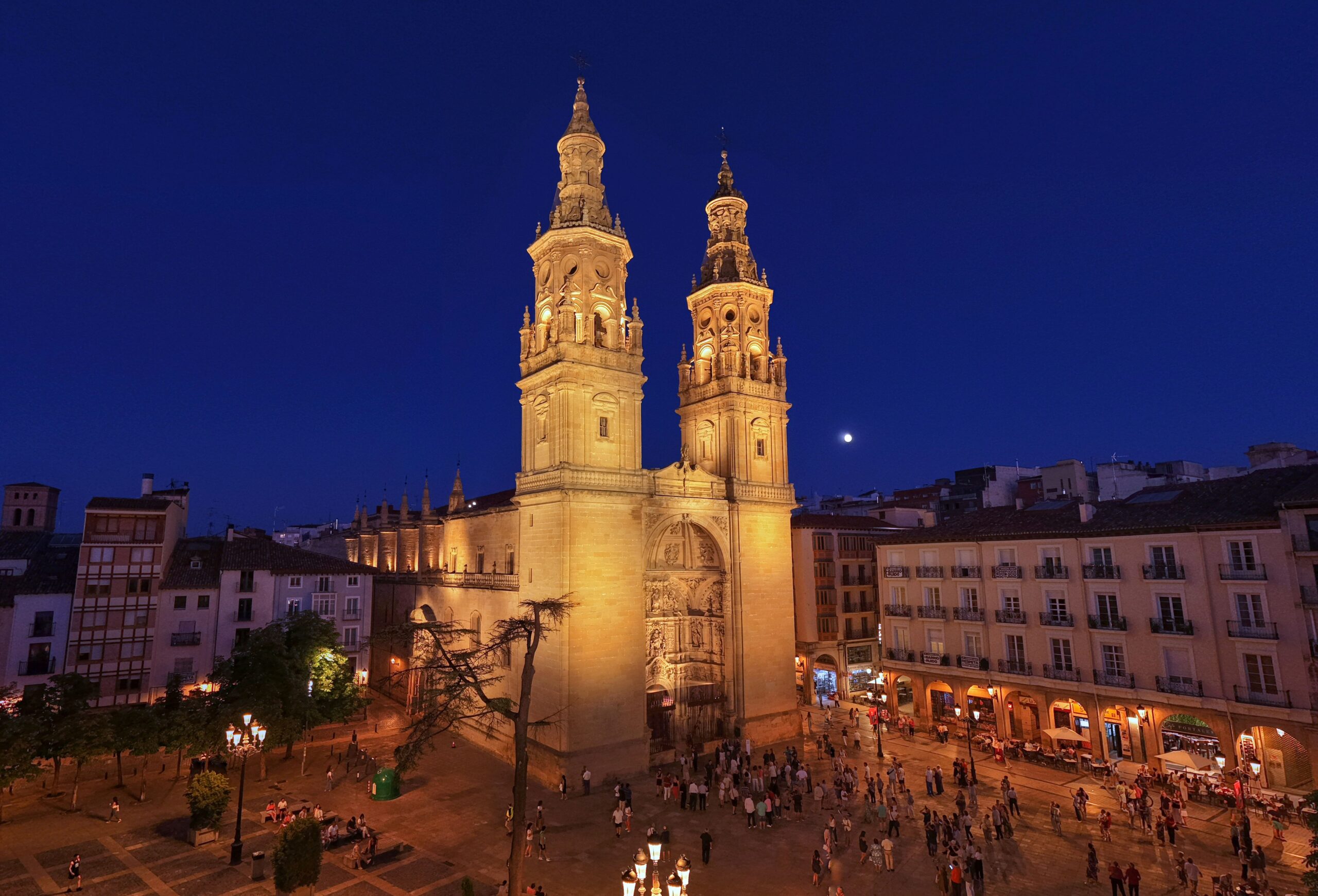
Santa María de la Redonda Co-Cathedral has undergone a comprehensive renewal of its exterior lighting system with the aim of restoring a faithful, balanced, and coherent night-time perception in keeping with its heritage value. Thanks to an investment of €225,000 by Fundación Iberdrola España, 122 new state-of-the-art LED luminaires have been installed, reaching a total installed capacity of 6,213 W.
Furthermore, the use of the latest-generation LED technology will reduce both the cathedral’s energy consumption and operating costs. The choice of warm lighting highlights the cathedral’s sandstone construction and the details of its impressive western façade, designed by Juan Bautista de Arbaiza, Juan Martín de Beratúa, and Francisco Gorbea.
The inauguration ceremony, held in Plaza del Mercado at the foot of the cathedral, was attended by Monsignor Santos Montoya Torres, Bishop of the Diocese of Calahorra and La Calzada-Logroño; Víctor Jiménez, parish priest of the Co-Cathedral; Conrado Escobar, Mayor of Logroño; Jaime Alfonsín, President of Fundación Iberdrola España; and Raquel Murillo, representing the company’s delegation in La Rioja, among others.
The Mayor of Logroño, Conrado Escobar, highlighted that:“La Redonda is one of Logroño’s great symbols and a heritage, cultural and spiritual landmark for our city. Thanks to the collaboration between the City Council, the Diocese and Fundación Iberdrola España, the Co-Cathedral now has a new ornamental lighting system that enhances its architectural beauty and further highlights one of our most emblematic buildings. This new lighting improves the experience of the thousands of people who visit La Redonda every year and helps make our historic centre an increasingly attractive, welcoming, and vibrant place.”
He added: “This project is an example of how collaboration between institutions helps preserve, protect, and promote our heritage. It also complements the initiatives the City Council has been advancing to renew lighting throughout Logroño’s historic centre, contributing to the revitalisation and enhancement of one of the city’s most key areas.”
Monsignor Santos Montoya Torres, Bishop of the Diocese of Calahorra and La Calzada-Logroño, thanked Co-Cathedral parish priest Víctor Jiménez for his dedication and leadership in driving the project forward.
“This initiative is the result of dialogue, cooperation and collaboration between the Church, public institutions, and businesses. When we join forces, the outcome benefits the conservation, enhancement, and dissemination of our heritage. La Redonda belongs to the Church, but it is also a shared asset for all the people of Logroño and La Rioja. Its new lighting beautifies the city, strengthens its tourist appeal, and offers residents and visitors a renewed image of one of La Rioja’s most emblematic churches.”
According to Jaime Alfonsín, President of Fundación Iberdrola España: “The conservation of heritage involves not only protecting and preserving our monuments but also ensuring that they can continue to be admired and enjoyed by present and future generations. Through this intervention, Fundación Iberdrola España reaffirms its commitment to protecting and enhancing Spain’s cultural heritage, demonstrating how innovation and sustainability can help highlight the great monuments that form part of our history and collective identity.”
Origin and history of the cathedral
The Diocese of Calahorra and La Calzada-Logroño is unique in having three cathedral seats: Santa María Cathedral in Calahorra, Santo Domingo de la Calzada Cathedral, and Logroño Co-Cathedral. Located in the heart of the city’s historic centre, the latter stands on the site of an earlier Romanesque church with a circular or polygonal layout, from which it derives its traditional name, “La Redonda.”
In 1435, it was elevated to the rank of collegiate church following its merger with the Church of San Martín de Albelda, and in 1959 it became a co-cathedral. The current building is the result of a lengthy construction process spanning the 16th to the 19th centuries. Its main structure is a Gothic church from the period of the Catholic Monarchs, begun in the early 16th century.
Lateral chapels were added and enriched during the 16th and 17th centuries. In the 18th century, some of the cathedral’s most distinctive external elements were incorporated, including the Baroque Chapel of Nuestra Señora de los Ángeles, the western façade-altarpiece and the twin towers, built between 1742 and 1762. These towers are among the finest examples of Baroque architecture in La Rioja and have become the cathedral’s most recognisable feature.
The final major extension took place in the 19th century with the construction of the present ambulatory, completing the spatial configuration of the complex.
125 Years of Energy: a programme of initiatives for society
This agreement forms part of the extensive programme of activities designed for 2026 to mark the 125th anniversary of Iberdrola’s founding. Under the slogan “125 Years of Energy”, the company will launch initiatives aimed at employees, customers, shareholders and the wider public, highlighting its legacy, future vision, and commitment to the communities where it operates.
Fundación Iberdrola España: promoting art and culture.
One of Fundación Iberdrola España’s principal areas of activity is the preservation, conservation, and enhancement of Spain’s historical and artistic heritage. Through its Lighting Programme, the Foundation develops interventions in landmark buildings to install or improve interior and exterior lighting systems, helping to enhance the value of historic and artistic heritage. In La Rioja, notable initiatives include the ornamental lighting of the Monastery of Yuso, the restoration of manuscripts held in its library in San Millán de la Cogolla, and the lighting of the façade of the Palacio de los Chapiteles.