‘Arte para Tocar’, a visual accessibility programme, a collaboration between the Bilbao Fine Arts Museum and Fundación Iberdrola España
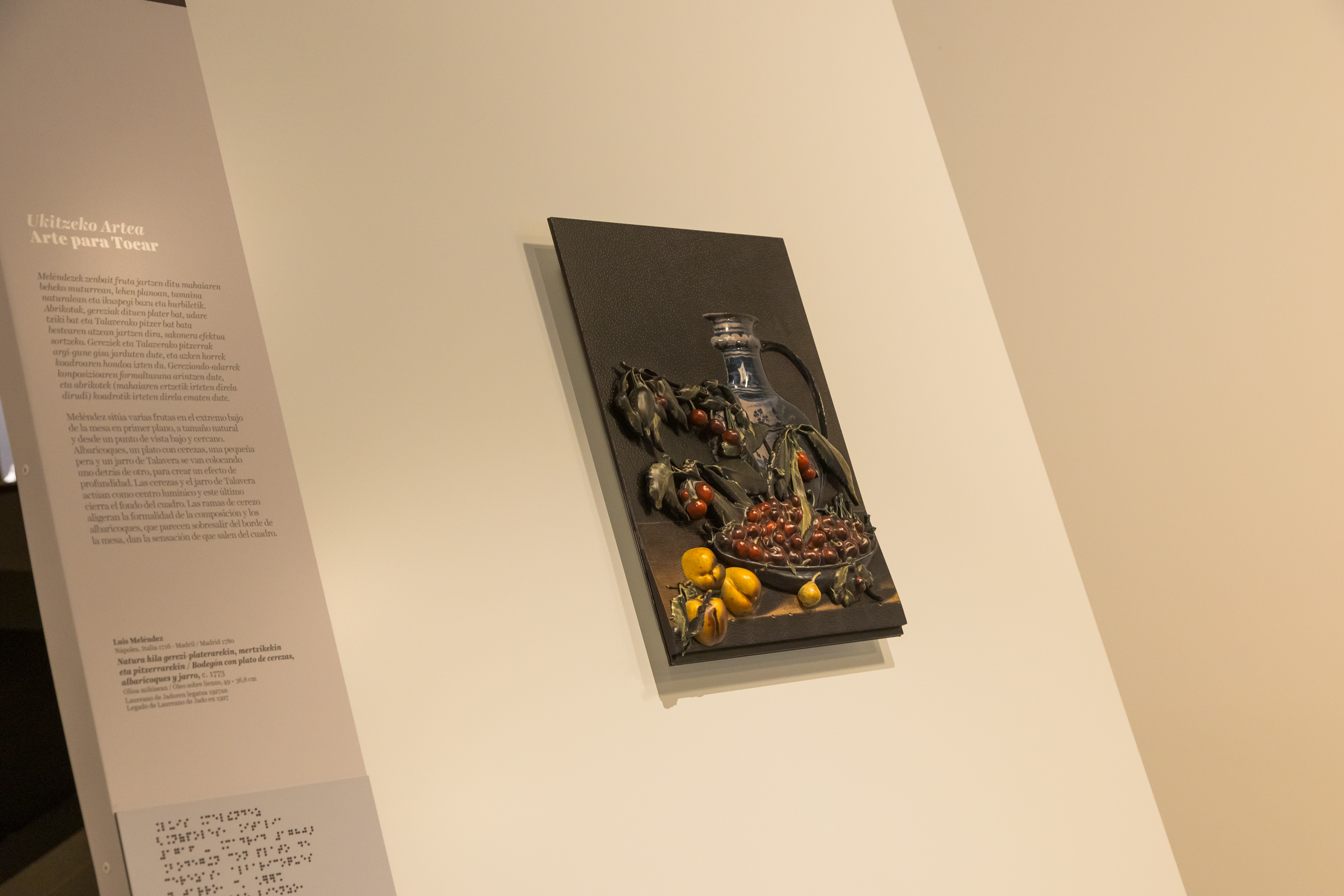
- The visual accessibility programme Arte para Tocar is expanding its collection with a work by the painter Luis Meléndez (Naples, 1716 – Madrid, 1780), an undisputed master of still life painting, renowned for his exceptional ability to depict the tactile qualities of objects
In 2012, Iberdrola and the museum launched this initiative aimed at people with visual impairments, integrating tactile experience into museum practice through relief reproductions of artworks. Since then, across its ten previous editions, the programme has welcomed 16,395 participants and 82 Primary and Secondary Education centres from Biscay, Gipuzkoa and Álava.
Building on this pioneering programme developed by the Bilbao Fine Arts Museum, other major cultural institutions such as the Museo del Prado and the Thyssen‑Bornemisza Museum in Madrid, as well as the Pushkin Museum in Moscow, have incorporated this initiative into their educational activities.
Arte para Tocar is based on technology developed by the Biscayan company Estudios Durero, which makes it possible to give relief to digital images of artworks. The process begins with a high‑resolution photograph, from which the most significant parts of the composition are selected to guide the hands of visually impaired visitors. After defining the volumes and textures, these are printed using a special ink, and a chemical process provides three‑dimensional relief to elements that are originally flat. The image is then printed at scale and in a size suitable for tactile exploration.
Alongside its main goal of accessibility, Arte para Tocar offers an awareness‑raising experience for all students, led by museum education staff, highlighting the potential of the sense of touch and supported by materials such as braille texts and blindfolds.
Each panel also includes an audio guide in Basque, Spanish and English, offering a suggested tactile route across the surface to help interpret the artwork.
Iberdrola’s long‑standing support for this initiative is complemented by the collaboration of the CRI – Educational Inclusion Resource Centre for Students with Visual Disabilities, part of the Department of Education of the Basque Government. The CRI advises the museum’s Education Department on practical aspects of the programme.
Luis Meléndez (Naples, Italy, 1716 – Madrid, 1780), Still life with a plate of cherries, apricots and a jug, c. 1773
This still life is a highly representative example of the work of Luis Meléndez, one of the great masters of still life painting—not only in Spain, but in all of Europe during his century.
Meléndez was the son of a miniature painter from Naples who was involved in attempts to establish an Academy of Fine Arts in Madrid. His father’s arrogance led to conflicts with colleagues, and the son suffered the consequences, being expelled from the Academy in 1748. In earlier years, Luis had been under the protection of Louis‑Michel van Loo, the French painter appointed to the court of Philip V, but the incident forced him to move to Italy, where he completed his training in Rome and Naples. Upon returning to Spain in 1753, after working as a miniature painter on the palace choir books, he attempted to secure a position as court painter to Charles III, but his petitions went unanswered. This pushed him to specialise in still life painting—a genre with steady market demand—in which he achieved unparalleled virtuosity.
Meléndez’s still lifes, like this one, are characterised by their simple compositions and depictions of everyday objects, typically rendered with a monumentality and rigour that contrast with their humble nature. He showed an obsession with meaningful detail and with the varied textures of objects—fruit, pottery, bread, vegetables—creating endless variations with these elements. His still lifes survive from as early as 1750 to 1778.
In this work, the Talavera jug stands out for its sheen, contrasting with the velvety surface of the peaches, the smoothness of the cherries and the soft, powdery texture of the leaves.