
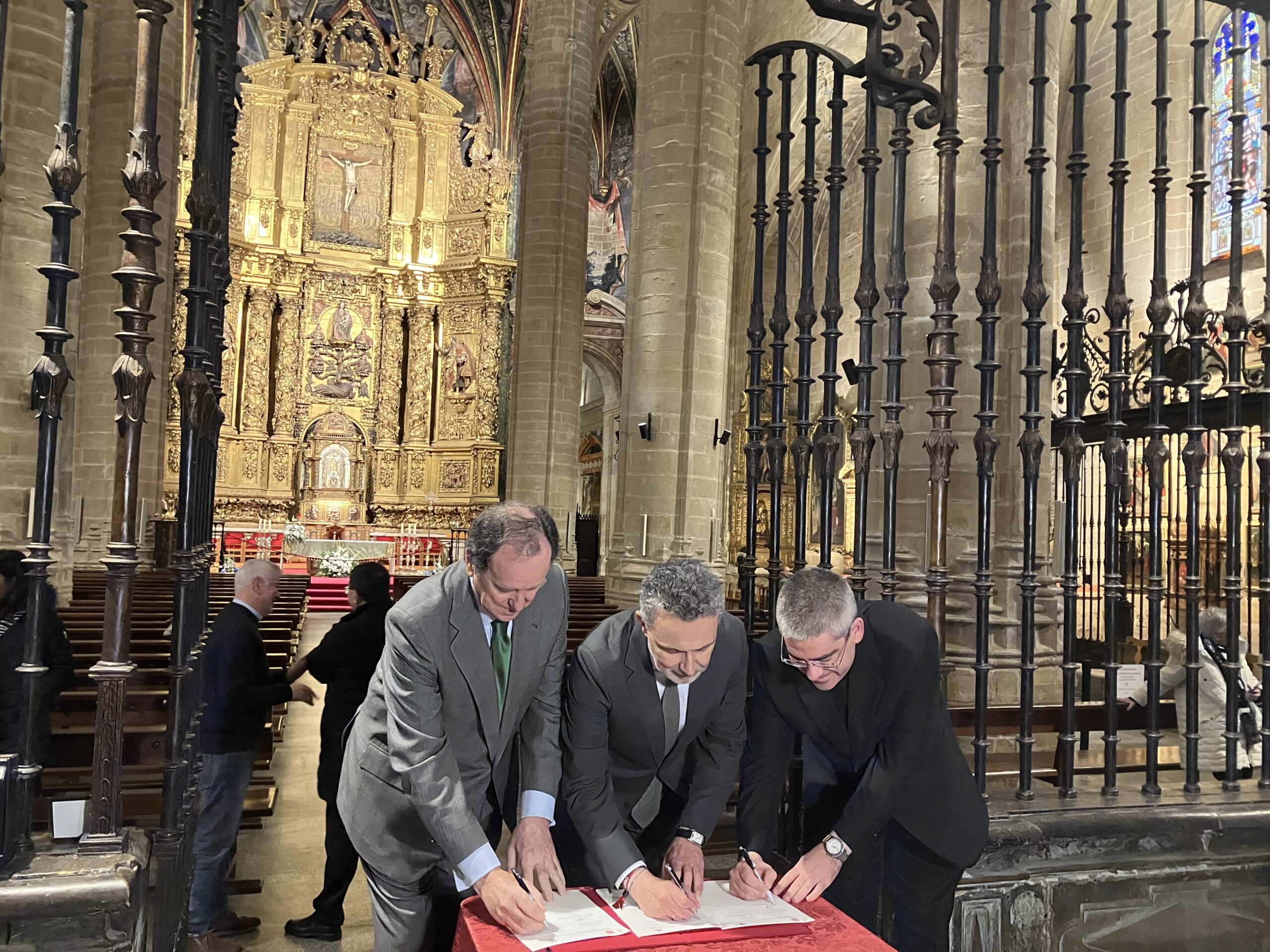
The Co‑Cathedral of Santa María de la Redonda will feature new exterior ornamental lighting thanks to Fundación Iberdrola España
- Through this collaboration agreement with the Logroño City Council and the Diocese of Calahorra y La Calzada‑Logroño, the exterior lighting of the temple will be upgraded with state‑of‑the‑art LED technology that will contribute to reducing its CO₂ emissions as well as its energy consumption
- This initiative by Fundación Iberdrola España seeks to highlight the historical and cultural heritage of the region, with the Co‑Cathedral of Santa María de la Redonda standing as an architectural and urban landmark
- Likewise, this lighting renovation is part of the activities of the Lighting Program planned for the company’s 125th anniversary
The Co‑Cathedral of Santa María de la Redonda will feature a new exterior ornamental lighting system following the signing of the agreement between the Diocese of Calahorra y La Calzada‑Logroño, the Logroño City Council and Fundación Iberdrola España.
The project, with an investment of 225,000 euros, includes the installation of new state‑of‑the‑art LED luminaires designed to reduce the temple’s energy consumption while enhancing its architectural heritage. The new warm lighting will emphasize the sandstone ashlar construction of the building and highlight one of its most spectacular elements: the grand western façade, the work of Juan Bautista de Arbaiza, Juan Martín de Beratúa and Francisco Gorbea.
The signing ceremony and subsequent visit, held at the Co‑Cathedral, was attended by Jesús Ignacio Merino, diocesan heritage delegate; the Mayor of Logroño, Conrado Escobar; Jaime Alfonsín, president of Fundación Iberdrola España; as well as other representatives including Víctor Jiménez, parish priest of the Co‑Cathedral, and Eduardo Ryan, the company’s institutional delegate in La Rioja.
Mayor Conrado Escobar stated: “Thanks to the collaboration between the City Council, the Diocese and Fundación Iberdrola España, we will have new lighting for La Redonda that will further enhance its heritage value as one of the most emblematic buildings in our city. The experience of the thousands of people who visit the co‑cathedral—parishioners, pilgrims, residents of Logroño and tourists—will be greatly improved thanks to this lighting, which joins other initiatives we have been implementing to improve the lighting of our historic center.”
Likewise, the diocesan heritage delegate, Jesús Ignacio Merino, said: “I would like to express my gratitude for the interest shown by Fundación Iberdrola and by the City Council of Logroño in the conservation of La Rioja’s historical and cultural heritage, and especially that of the Co‑Cathedral of Santa María de la Redonda. This commitment is the result of the strong relationships between public and private institutions and the Co‑Cathedral Chapter, enabling society as a whole to collaborate actively in the proper conservation of our heritage. Light is essential for understanding and fully appreciating heritage, as it reveals its beauty, meaning and historical and spiritual value.”
For Jaime Alfonsín, president of Fundación Iberdrola España, “It is an honour for Fundación Iberdrola España to collaborate in the new exterior lighting of the Co‑Cathedral of Santa María de la Redonda, one of the great heritage references of the city and the region. With this project, we reaffirm our commitment to heritage conservation through initiatives that combine innovation, energy efficiency and respect for our cultural legacy for future generations.” He also highlighted that this intervention forms part of the company’s 125th anniversary Lighting Program.
Origin and history of the Cathedral
The Diocese of Calahorra y La Calzada‑Logroño is unique in that it has three cathedral seats: the Cathedral of Santa María de Calahorra, the Cathedral of Santo Domingo de la Calzada and the Co‑Cathedral of Logroño.
Located in the heart of the city’s historic quarter, the Co‑Cathedral stands on the site of an earlier Romanesque church with a circular or polygonal plan, which gave rise to the traditional name “La Redonda.”
In 1435 it acquired the status of Collegiate Church following its merger with the Church of San Martín de Albelda, and in 1959 it was elevated to Co‑Cathedral. The current building is the result of a long construction process spanning the 16th to the 19th century. The main structure corresponds to a Gothic building from the time of the Catholic Monarchs, begun in the early 16th century. It features a hall plan, with three naves of equal height separated by slender cylindrical columns supporting star‑shaped and tierceron rib vaults typical of the northern Iberian Peninsula.
During the 16th and 17th centuries, the lateral chapels were added and enriched between the buttresses. In the 18th century, the most distinctive exterior elements were incorporated: the Baroque chapel of Nuestra Señora de los Ángeles, the altarpiece‑style western portal, and the twin towers, built between 1742 and 1762. These highly vertical towers, articulated in four sections, are among the most outstanding examples of Riojan Baroque architecture and have become the most recognizable profile of both the temple and the city. The final extension took place in the 19th century with the construction of the current ambulatory, which extends the apse and completes the spatial layout of the ensemble.
125 Years of Light: A Broad Program of Initiatives for Society
This agreement is part of the extensive program designed for 2026 to mark Iberdrola’s 125th anniversary, which includes art exhibitions, music festivals, technological showcases, and social events. Under the motto “125 Years of Light,” the company will launch initiatives aimed at employees, customers, shareholders, and the general public to highlight its legacy, share its vision and future perspectives, and reaffirm its strong commitment to the communities in which it operates.
Iberdrola and the promotion of art and culture
One of Iberdrola’s main areas of activity, through its foundation in Spain, focuses on the care, conservation and enhancement of historical and artistic heritage. The Lighting Program aims to carry out interventions in significant buildings to install or improve their interior and/or exterior lighting systems, in order to highlight historical and artistic heritage.
In the Chartered Community of Navarre, a notable project is the interior and exterior ornamental lighting of the Humilladero de Allo, in the Estella region—built in 1575 and classified by the regional government as a singular building of great historical value.